
Tune History

The Stories Behind Your Favorite Tunes

Moses Hoe The Corn
From "Razors In The Air," an 1880s minstrel tune

“Moses Hoe The Corn" (alternately “Hoe The Corn Moses”) is an often heard Old Time jam favorite. It is a two part D tune that is easy to learn and play. The version we recognize now is a folk-processed adaptation of the late 1800s minstrel tune called “Razors In The Air.” The original was written by William H. “Harry” Kennedy, who was a popular ventriloquist, songwriter, and music publisher. Kennedy was an accomplished performer, touring with major minstrel troupes of the day, and is credited with writing over 200 songs.
The original song had three parts with lyrics. The chorus is where the name came from:
Get away from that window, My love and my dove
Get away from that window, Don't you hear - Oh my yes-
Come some other night, For there's gonna be a fight
There'll be razors a-flying in the air
Fast forward to the 1970s - and let the folk process begin! Fiddler and collector Kerry Blech explains to Slippery Hill that his friend Pat Conte, a self described amateur musicologist and record/instrument collector, used a 1929 Vernon Dalhart recording (more on Dalhart below) as a starting point to "re-compose" “Razors In The Air” as a two part blues fiddle tune in the key of E major. The “razors in the air” chorus was not used in Conte’s version. He drew his title "Moses Hoe The Corn" from the original’s other repeated lyrics:
Hoe that corn
Hoe the corn Moses
Oh, hoe that corn
Oh, Moses hoe the corn
Blech shares that he liked what Conte had done, but he decided to turn Conte’s version into a two part Old Time tune in the key of D that his band could use for square and contra dances. Blech then goes on to tell of teaching his dance version to the Canote Brothers while visiting the West Coast on tour in the 1980s. The tune caught on out West, was spread by the Canote’s touring and at jams and festivals. An example of today’s jam version is in the video below, as well as Kerry Blech himself on solo fiddle in the mp3 player. (Ed.note: I also included a version from Mike Burns’ and Mark Piro’s 2026 album in the video section. It’s a little different take, and in the key of G, but I think you will like it. The folk process continues…)
A Little More History of “Razors In The Air”
The Shows
In the 1880s, the song was popularized by singer Barry Maxwell, performing with Haverly’s United Mastodon Minstrels. J.H. Haverly (1837-1901) was one of the first minstrelsy producers who was not a performer himself. He was a businessman who dramatically changed the way minstrel shows were presented by combining multiple minstrel groups into one large event. Instead of the usual performing troupe of 4-6 artists, he presented a lavish production of between 40 and 100 entertainers, complete with costumes, sets, special effects, a brass band, and a drum corps. Haverly’s presentations were heavily advertised, and became arguably one of the most popular exhibitions of the late 19th century. They were so large that Haverly coined the odd name “Mastodon” minstrels as a way to convey that this was the largest show of its kind. After touring in Europe, he added to the name, which then became “Haverly’s European Mastodon Minstrels.” Later, Haverly was also one of the first to add his production formula to minstrel shows featuring all Black entertainers, at a time when the accepted norm was to employ only white performers in blackface.
The Records
Minstrel tunes in general were, by far, the most popular types of records from the 1890s to the early 1900s. And the sheet music for these tunes was widely distributed. Three recordings of “Razors In The Air” extended the life of this particular tune even further.
The first was in 1920, performed by Harry C. Browne and Peerless Quartette. It was released on Columbia Records as a “Baritone solo and male quartette with orchestra and banjo accompaniment.” Harry Clinton Browne (1878-1954) was a banjo player, singer, and actor. After performing in vaudeville shows for many years, Browne recorded dozens of titles for Columbia between 1916 and 1928. Besides a series of minstrel songs, his repertoire also included many popular hymns. As an actor, Browne appeared in at least 14 Broadway shows between 1906 and 1925 and in more than a dozen silent movies between 1914 and 1921.
The second was the 1929 recording by Vernon Dalhart, with an uncredited accompaniment by Adelyne Hood. It was released as “Razor’s In De Air” on various labels, including Velvet Tone and Diva, as “Vocal novelty accompaniment” (in the video below). Dalhart (1863-1948) was a country/hillbilly singer and songwriter whose real name was Marion Try Slaughter II. He used over 100 pseudonyms to record prolifically during the 1920s and 30s, releasing or singing on more than 5,000 singles for multiple labels. He was inducted into the Nashville Songwriters Hall of Fame in 1970, and the Country Music Hall of Fame in 1981. Adelyne Hood (1897- 1958) was a fiddle player, singer, and songwriter also known as Betsy White. In the early 1920s, she embarked on a career as a vaudeville performer, and with Vernon Dalhart and Carson Robison, she was part of the Dalhart-Hood-Robison trio.
In 1961, and at the height of their folk music popularity, The Kingston Trio released “Razors In The Air" as a track on their album, “Goin’ Places.” While their lyrically sanitized version of the minstrel tune was not individually significant, the album was - peaking at number three on the Billboard charts and spending 41 weeks in the Top 40.
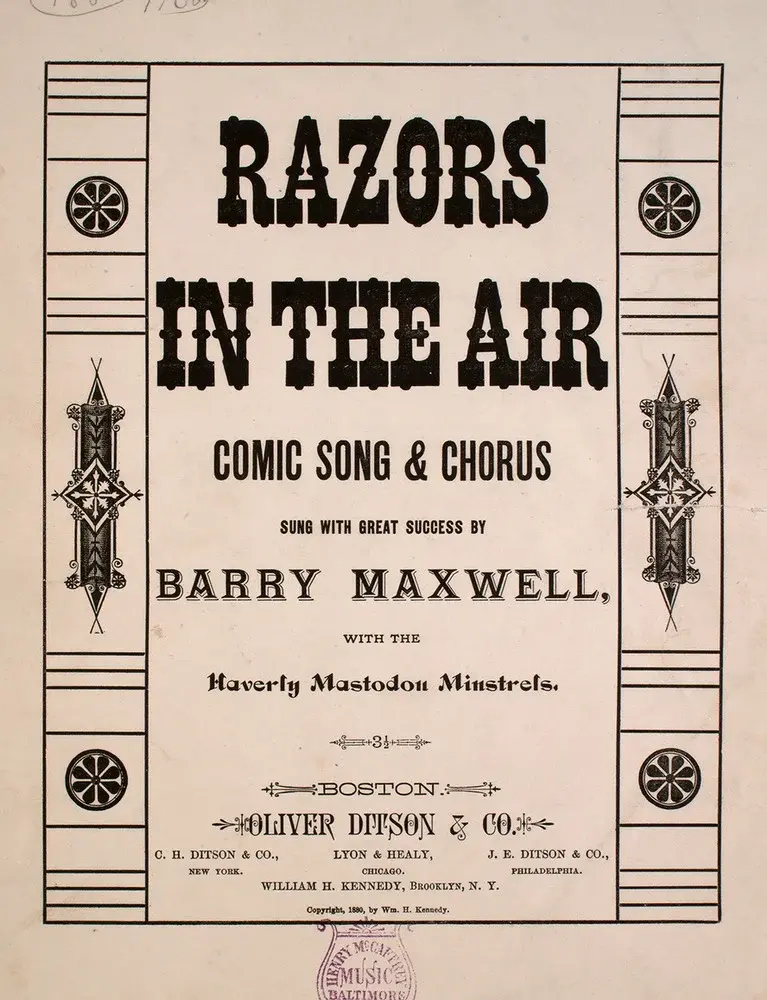


Razors In The Air
1920 Recording by Harry C. Browne and Peerless Quartette
Moses Hoe The Corn
2025 Clifftop Jam
Moses Hoe The Corn (in G)
from the 2026 Browns Creek album from Burns and Piro
9/1/26