
Music


John L. "Uncle Bunt" Stephens
Tennessee's 1926 Henry Ford Fiddle Contest Champion?
John L. "Uncle Bunt" Stephens (February 2, 1879 – July 25, 1951) was born in Bedford County, Tennessee. Orphaned at a young age, he was raised by an aunt in the small community of Flatcreek (between Shelbyville and Lynchburg). He was an entirely self-taught musician, starting with the harmonica as a child. According to family lore, he bought his first fiddle from a traveling hobo for $25 when he was 11 years old. By age 17, he was playing for local square dances and parties. For most of his adult life, Stephens worked as a farmer and on a road construction crew, while continuing to play music locally.
Uncle Bunt's quiet life was to change dramatically due to a nationwide interest in Old Time music sparked by automobile magnate Henry Ford. Ford reportedly believed that modern, jazz-inspired music and dances like the Charleston were corrupting American young people. Starting in 1925, he began an active campaign to restore the square dances and music of his youth. As part of this effort, Ford encouraged his local dealerships across the country to host community fiddle contests and old-time dances. Ford’s resources were vast, and the Ford Motor Company even had multiple Company bands and a corporate Music Department. But these things were also part of Ford’s larger social agenda, as researchers cite his push for traditional music and dance as “… part of his broader efforts at Americanization through leisure reform.”
For those seeking a deep dive into Ford’s Music Department and his leisure reform endeavors, please see this 2016 Cambridge University publication. For more details on Ford’s dance and fiddle revival, here is a lengthy article from the Square Dance History Project’s website site called ”Henry Ford’s Dance Revival and Fiddle Contests: Myth and Reality.”
In 1926, Uncle Bunt Stephens entered a series of Ford dealer sponsored fiddle competitions, first winning a local contest at a Lynchburg dealership. This gave him the opportunity to travel to the state contest at Nashville. Stephens’ third place finish at the standing room only competition at the Ryman auditorium, and subsequent 2nd place win at a regional contest in Louisville, KY, earned him an invitation to Detroit, Michigan to play for Henry Ford. Quite a bit has been written about a national competition held by Henry Ford in Detroit, and Uncle Bunt winning that event. But did that really happen?
Not exactly, according to The McNairy County (TN) News in a 2023 guest column series: “Several fiddlers—Stephens among them—apparently did play for Henry Ford at a Detroit gathering of Ford executives and dealers, but there is no record of a fiddle contest taking place, let alone the crowning of a national champion. Stephens, whose yarn spinning rivaled his fiddling, told Nashville reporters that he attempted to bow out of the contest with the excuse that he’d only split enough wood to last his family three more days. He claimed Henry Ford dispatched one of his agents to Lynchburg to provision the Stephenses with wood and other necessities, set him up in a private room at the Ford estate, and bestowed on him the title of national old-time fiddle champion. What really happened in Detroit is unclear, but a good Southern tale relies more on the quality of the story than the facts, so Stephens’ humorous version of events persists in Tennessee music lore.”
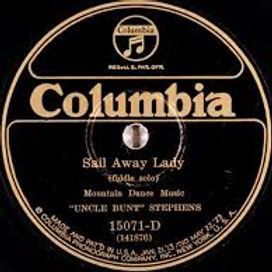
Not disputed is that, following his success in the Ford dealership contests, Stephens embarked on a brief tour. He appeared on several early broadcasts of the Grand Ole Opry (then called the WSM Barn Dance) and on radio stations in Chicago. Columbia Records brought Stephens and his new wife to New York City, where he recorded his only known musical tracks. Stephens recorded several instrumentals, but only "Sail Away Lady," “Left In The Dark Blues,” "Candy Girl," and "Louisburg Blues" were released. Here is the New York Times story about his visit on March 26, 1926.
After his brief encounter with national stardom, Stephens chose to return to his farm in Moore County, near Lynchburg, where he lived until his death in 1951.
In 1952, Smithsonian Folkways issued the “Anthology of American Folk Music”. This collection of recordings included Uncle Bunt’s rendition of “Sail Away Lady.” The liner notes for the track read: “This performance is probably similar to much American dance music in the period between the Revolutionary and Civil Wars.” Later, a scholarly paper entitled “The Technique of Variation in an American Fiddle Tune (A Study of ‘Sail Away Lady’ as it was performed in 1926 for Columbia Records by ‘Uncle Bunt’ Stephens)” was published in the January 1968 issue of “Ethnomusicology,” a publication by the University of Illinois Press for The Society For Ethnomusicology. (For an even more in-depth tune history of Sail Away Lady, see this informative installment from Anthology Revisited.)
Because of its inclusion in the Folkways anthology and the scholarly interest in “Sail Away Lady,” the recording attracted the attention of folk music revivalists of the 1950s and 1960s. This all combined to help recognize Uncle Bunt Stephens as a foundational figure in Old Time music.
Stephens’ recording of Sail Away Lady should remind us all to never underestimate the power of a simple tune performed well. Or the importance of a good story told well.


Columbia 15071-D 1926
Louisburg Blues
Sail Away Lady
Candy Girl
8/1/26